Posts

A Meeting with a remarkable tree!

Image
This is me, with Monty the dog, sitting in the courtyard of Skipton Castle under the yew tree that was planted in 1659 by Lady Anne Clifford to mark the repair of the castle after the English Civil War. Despite enduring a three year siege during the Civil War, Skipton is one of the most complete medieval castles in England. The yew tree stands in the Conduit Court (so called because it was where the spring water bubbled out) in the centre of the castle, surrounded by a range of early Tudor buildings that remain unaltered and intact. I've never seen a tree growing inside a castle courtyard like this before although my husband swears he has been somewhere else where there was a tree just like this - and he has been racking his brains ever since to try and remember where it was! It was very peaceful and cool to sit beneath this ancient tree on what was a very hot day and read all about the castle in the guidebook. It was also very nice to be able to take our very well-behaved dog int...

Literary Leanings in Kildwick - Nicola's research trip part 2!

Image
After we picked up our narrowboat we set off westward along the Leeds to Liverpool Canal. Our first stop was at Kildwick in the area known as Craven in Yorkshire. During the 1970s I sang in the choir of the parish church here with my grandparents and I had not been back since they left when I was 11 years old. It was exactly as I remembered it and I felt a very strong sense of nostalgia. The original Saxon church at Kildwick dated back to the 10th century. It had a heavy oak- timbered roof thatched with straw overlaid with turf and a very broad low tower. Some of the stone from the Saxon churchyard cross was found embedded in the wall of the current church chancel in the early 20th century. The rest of this early church has vanished, replaced by a medieval building that is very beautiful. In the same period the earliest bridge over the River Aire was built at Kildwick, costing £21.12.09. The box pews or ‘close pues’ or ‘privey closets’ as they were called in the 17th century with door...

Overwhelmed at Hardwick Hall!

Image
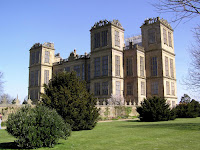
This is Hardwick Hall on the border of Derbyshire and Yorkshire, a house described as "more window than wall." I'd never been to Hardwick Hall before last weekend, a shocking omission when I consider myself to be a fan of the Tudor period and of Bess of Hardwick in particular, that tough, shrewd woman who worked her way up society from her beginnings as the daughter of a poor gentry family and ended up founding a dynasty. One of the first historical novels I read was a fictional biography of Bess of Hardwick entitled only "Bess." It enthralled me and fostered my fascination with history and I dearly wish I had kept my copy or could at least remember the author's name. So last weekend, on the way to my research trip/canal boat holiday in Yorkshire, I finally made my pilgrimage to Hardwick Hall. When I came out of my tour of the house I was so stunned and over-awed I couldn't speak for about an hour. This happens to me sometimes when I've seen a play...

Not What You Expect to See...

Image
Last weekend I was out on a walk in Oxfordshire near Henley-on-Thames and came across something I never expected to see in the English countryside. This. I suppose I should have learned by now to expect the unexpected - Britain is eccentric in so many ways and so to find an Indian-style obelisk in a small village is not that surprising. This is The Maharajah's Well in the village of Stoke Row. It was a gift to the people of Stoke Row from the Maharajah of Benares, a friend of a prominent local landowner, Mr Edward Anderdon Reade. Mr Reade was Governor of the Northwest Provinces of India and during his time there presented a well to the people of India. As there was an absence of available water in the Stoke Row area, the Maharajah generously reciprocated the gesture to demonstrate his feelings for England and as a token of friendship with Mr Reade. Work on the well commenced in 1863 and it was officially opened just over a year later. It is 368 feet deep (taller than St Paul's...